ONLY ZERO CARBON ONLY ZERO CARBON ONLY ZERO CARBON ONLY ZERO CARBON ONLY ZERO CARBON
What zero carbon means
for climate change education, planning, and policy making
What is carbon neutral?
What is net zero carbon?
We are hearing increasingly about 'carbon neutral' or 'net zero'.
Net zero in 2021 is almost only target we hear about, but it is phony target for fake mitigation.
11 Dec 2020 10 myths about net zero targets and carbon offsetting, busted, by climate change experts
What is net zero carbon?
We are hearing increasingly about 'carbon neutral' or 'net zero'.
Net zero in 2021 is almost only target we hear about, but it is phony target for fake mitigation.
11 Dec 2020 10 myths about net zero targets and carbon offsetting, busted, by climate change experts
Climate change experts such as a 2008 report by the Global Carbon Project, suggest that carbon offsetting can contribute towards climate change mitigation. However these experts are taking a pragmatic approach to mitigation in the hope that this will result in some emissions reductions that may lessen the impacts and may put us on the way slowly towards a zero carbon world.
We are on the very brink of planetary catastrophe - it is far too late for slow improvement.
This approach is the personal voluntary one of small incremental steps towards less emissions. It is too late for this approach and for 25 years the growing environmental organizations and governments have been promoting and educating this personal lifestyle change approach. It has made no difference. Emissions are higher and increasing faster than ever.
To meet the scientific zero carbon requirements we must make radical revolutionary changes in national economies through radical revolutionary political changes. Leading institutions and organizations must lobby for these true zero carbon changes.
The way these terms are being used is very misleading. The only real carbon neutral or net zero is scientific virtual zero + negative carbon.
These terms are both used to mean the same thing.
It is impossible to get anywhere near zero carbon with this approach.
Carbon neutral or net zero carbon emissions is being understood to refer to achieving net zero carbon emissions by 'balancing' a certain measured amount of carbon released with an amount of carbon offsets. This assumes that land use change can be designed to take CO2 out of the carbon cycle. Buying enough carbon credits to make up the difference is even treated as a way to carbon neutral.
This is dangerously misleading. There is no such thing as offsetting carbon emissions over the long term. Radical emergency climate change mitigation now is essential when we look at the fact that today's emissions cause more global warming that will last thousands of years.
The terrestrial carbon cycle recycles land based carbon. While tree planting is highly desirable for environmental benefits it cannot remove carbon from the carbon cycle. The young trees will take up CO2 by photosynthesis from the air as they grow, and will return it to the atmosphere as they shed leaves, decay and die in decades or centuries. Also tree planting itself disturbs the forest floor releasing large amounts of CO2. Our tree planting reforestation practices tends to make artificial forests more vulnerable to spreading forest fires.
What is low carbon?
This is a confusing and potentially dangerous term. We hear of 'low carbon' more often than zero carbon.
First and foremost it must mean zero industrial carbon emissions.
If low carbon means about a 90% emissions reduction then it makes sense.
First and foremost it must mean zero industrial carbon emissions.
If low carbon means about a 90% emissions reduction then it makes sense.
Lower carbon cannot prevent planetary catastrophe because the carbon still accumulates in the atmosphere.
'Low carbon' as the term generally being applied does not work for getting us on the way to zero, because this version of low carbon relies on using fossil fuels more efficiently. We certainly do need to improve conservation and efficiency but that cannot be used as a reason to delay converting the world economy totally off fossil fuels.
- What does zero carbon mean?
- Isn't zero carbon impossible?
- What is low carbon?
- What is net zero?
- What is carbon neutral?
Zero carbon refers to zero carbon dioxide emissions, and can be applied to CO2 equivalent emissions, that takes in the other GHG emissions
It is a not an agreed scientific term but it is a scientific reality for climate change mitigation.
If any industrial pollution CO2 is added to the atmosphere stabilization of atmospheric CO2 cannot happen - that is the scientific reality. Nor can stabilization of ocean acidification
In fact we have been adding some carbon to the atmosphere (CO2 and methane CH4) since agricultural civilizations developed. With the industrial revolution that additional carbon started to increase and soon was increasing at an exponential rate.
Isn't actual zero carbon impossible?
It is impossible for us, with our current knowledge, to stop all CO2 emissions from human activities.
For example we have no way at present to stop all CO2 emissions from agriculture. Zero carbon therefore today means virtual zero carbon (at least a 90% reduction of carbon emissions.
We can make major reductions in agricultural carbon emissions because today's agriculture is so carbon intensive and carbon emitting.
It is impossible for us, with our current knowledge, to stop all CO2 emissions from human activities.
For example we have no way at present to stop all CO2 emissions from agriculture. Zero carbon therefore today means virtual zero carbon (at least a 90% reduction of carbon emissions.
We can make major reductions in agricultural carbon emissions because today's agriculture is so carbon intensive and carbon emitting.
Research shows that organic farming methods are the best for carbon balance.
There is no reason to think that if large resources are applied for research into converting all our carbon sources to zero carbon services and technologies we could not redevelop for a true zero carbon world. This is a possibility for the future that we must work towards.
The best that we can achieve with today's knowledge is what the scientists call 'virtual zero' carbon emissions - at least a 90% reduction. Low carbon or net zero carbon could also mean this
To achieve actual zero carbon in the scientific sense the scientists say we must develop the capacity for 'negative carbon' emissions, meaning we have to extract some CO2 directly out of the air and secure it.
To achieve actual zero carbon in the scientific sense the scientists say we must develop the capacity for 'negative carbon' emissions, meaning we have to extract some CO2 directly out of the air and secure it.
Right now we are planning on leaving it too late. The best proposals are for virtual zero by 2050 and for actual zero after the end of this century.
The net effect of virtual zero carbon and some negative carbon is true zero carbon.
Virtual zero carbon + some Negative carbon = Zero carbon
We know we can do virtual zero carbon (@ 90% reduction of emissions) by converting all fossil fuel energy CO2 sources to zero carbon clean energy and stop deforestation.
For negative carbon the scientists say we must develop 'artificial carbon sinks' the main one being by CO2 air extraction. We have technologies to take CO2 out of the air. They are not being developed because there is no money for it and no profit in it.
For negative carbon the scientists say we must develop 'artificial carbon sinks' the main one being by CO2 air extraction. We have technologies to take CO2 out of the air. They are not being developed because there is no money for it and no profit in it.
What does zero carbon mean?
For stabilization of climate and ocean acidification it (should) means that all industrial sources of CO2 have to be converted to run on zero carbon emitting energies.
As in the 2014 Climate Action network International's June 2014 Position Statement it means the end of the fossil fuel energy era, by all fossil fuel energy being replaced 100% by non polluting renewable energy.
As in the 2014 Climate Action network International's June 2014 Position Statement it means the end of the fossil fuel energy era, by all fossil fuel energy being replaced 100% by non polluting renewable energy.
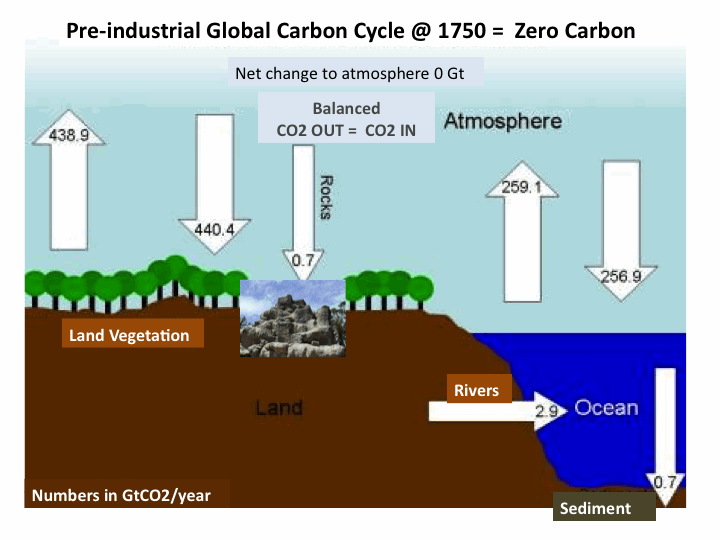
The several terms that are used with respect to the required target for carbon emissions makes for confusion as a 2015 climate science paper says. But one look at the table (opposite right) is no less confusing.
The best contribution to resolve the confusion come from the Climate Action Network 2014 Position paper. Climate Action Network calls for phasing out all fossil fuel emissions and phasing in a 100% renewable energy future with sustainable energy access for all, as early as possible, but not later than 2050. It also calls for an end to de-forestation (by 2020).
This is what this website means by zero carbon, and by using this straightforward definition there need be no confusion.
21 Oct 2015 Zero emission targets.
The best contribution to resolve the confusion come from the Climate Action Network 2014 Position paper. Climate Action Network calls for phasing out all fossil fuel emissions and phasing in a 100% renewable energy future with sustainable energy access for all, as early as possible, but not later than 2050. It also calls for an end to de-forestation (by 2020).
This is what this website means by zero carbon, and by using this straightforward definition there need be no confusion.
21 Oct 2015 Zero emission targets.
Carbon neutral and net zero as defined by UNEP (GAP report 2014)
'Global carbon neutrality means that, globally, anthropogenic carbon dioxide emissions are net zero.
Net zero implies that some remaining carbon dioxide emissions could be compensated by the same amount of carbon dioxide uptake (negative emissions), as long as the net input of carbon dioxide to the atmosphere due to human activities is zero'.
'Global carbon neutrality means that, globally, anthropogenic carbon dioxide emissions are net zero.
Net zero implies that some remaining carbon dioxide emissions could be compensated by the same amount of carbon dioxide uptake (negative emissions), as long as the net input of carbon dioxide to the atmosphere due to human activities is zero'.
They should all have one thing in common, which is that the world economic market economy must shift from fossil fuel energy to 100% clean renewable energy.
This is so for a zero, net zero or low carbon world economy.
This would start to happen with just the termination of of world fossil fuel subsidies. The result of this would be that renewable energy investment would increasingly take over from fossil fuel investment.
Another way of putting is is net zero is OK so long as there is no burning for energy.
However the climate science includes dubious net zero carbon ingredients such as biofuels and carbon-capture-storage. In this way zero carbon to the climate experts does not have to mean no burning or no fossil fuels for energy.
This is so for a zero, net zero or low carbon world economy.
This would start to happen with just the termination of of world fossil fuel subsidies. The result of this would be that renewable energy investment would increasingly take over from fossil fuel investment.
Another way of putting is is net zero is OK so long as there is no burning for energy.
However the climate science includes dubious net zero carbon ingredients such as biofuels and carbon-capture-storage. In this way zero carbon to the climate experts does not have to mean no burning or no fossil fuels for energy.
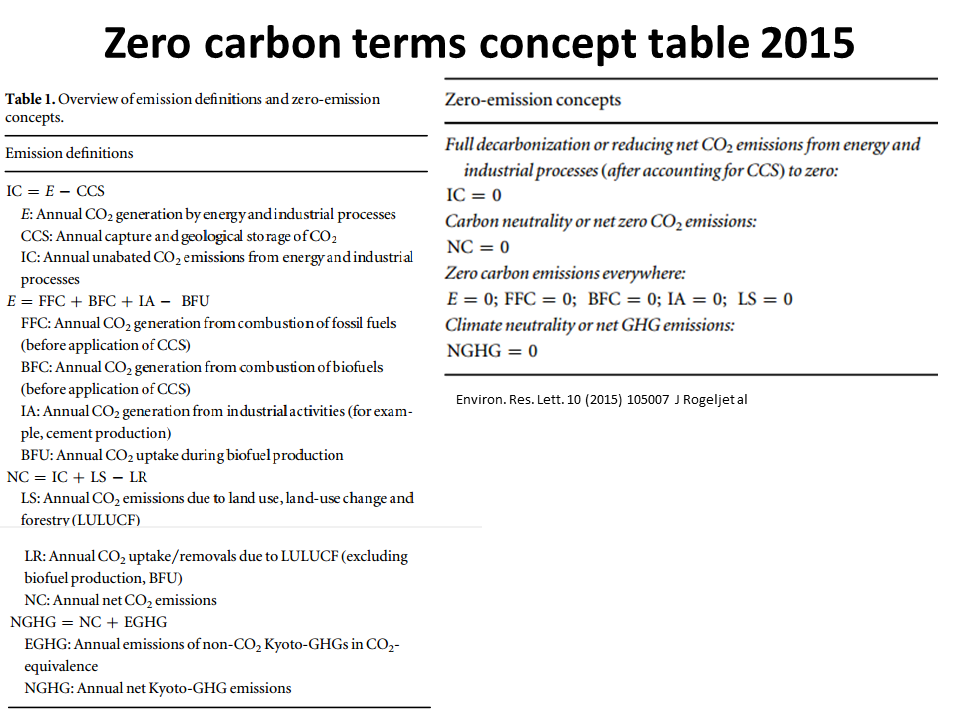
This science paper shows that there is no universal or UN Climate Secretariat agreed definition for any of the above. Except for zero carbon emissions, the terms can be interpreted differently. In the above paper the terms carbon neutrality, climate neutrality, full de-carbonization, and net zero carbon or net zero greenhouse gas(GHG) emissions- all assume successful carbon capture and storage or sequestration (CCS), with no limit put on the amount of carbon removal.
There is no agreed inclusion of cutting emissions and increasing carbon storage using natural processes in forestry or agriculture practices.
None of them assume the termination of fossil fuel combustion for energy. The paper calls zero carbon emissions a 'hypothetical concept'.
There is no agreed inclusion of cutting emissions and increasing carbon storage using natural processes in forestry or agriculture practices.
None of them assume the termination of fossil fuel combustion for energy. The paper calls zero carbon emissions a 'hypothetical concept'.
It is a scientific fact that global temperature/climate change AND ocean acidification cannot stabilize unless industrial age carbon emissions are zero i.e. no emissions of CO2 from all sources.
The IPCC (2014 AR5) uses does not use the terms net zero carbon, or carbon neutral.
It uses zero carbon, low carbon and 'net negative emissions' in place of net zero and carbon neutral which is clearer.
This site says zero carbon means:
>zero fossil fuel combustion for energy
>zero biomass combustion for energy
>zero biofuels combustion for energy.
>zero deforestation
>zero (CO2 emitting) cement manufacturing
Here is a dangerous definition from the Global Carbon Project, which is what the scientists in general are treating zero carbon as. 'Aim for zero net carbon emissions. We use carbon neutral as shorthand for zero net impact on radiative climate forcing'. This is dangerous because it ignores ocean acidifcation, as most do on the zero carbon topic.
It is also dangerous because it does not say that fossil fuel combustion for energy must stop,replaced bu new clean true zero carbon energy sources. Also it does not preclude geoengineering to cool the planet.
The IPCC (2014 AR5) uses does not use the terms net zero carbon, or carbon neutral.
It uses zero carbon, low carbon and 'net negative emissions' in place of net zero and carbon neutral which is clearer.
This site says zero carbon means:
>zero fossil fuel combustion for energy
>zero biomass combustion for energy
>zero biofuels combustion for energy.
>zero deforestation
>zero (CO2 emitting) cement manufacturing
Here is a dangerous definition from the Global Carbon Project, which is what the scientists in general are treating zero carbon as. 'Aim for zero net carbon emissions. We use carbon neutral as shorthand for zero net impact on radiative climate forcing'. This is dangerous because it ignores ocean acidifcation, as most do on the zero carbon topic.
It is also dangerous because it does not say that fossil fuel combustion for energy must stop,replaced bu new clean true zero carbon energy sources. Also it does not preclude geoengineering to cool the planet.