Recommended
IMF's May 2015 world energy subsidy review finds they have reached a shocking $5.3 Trillion US/year. Practically All nations are subsidizing fossil fuels, with most coming developing nations. The reason for that is half the world's subsidies are from China at $2.3 Trillion US, classified as a developing nation.
A study of the scandalous fossil fuel subsidies that are destroying our future by the
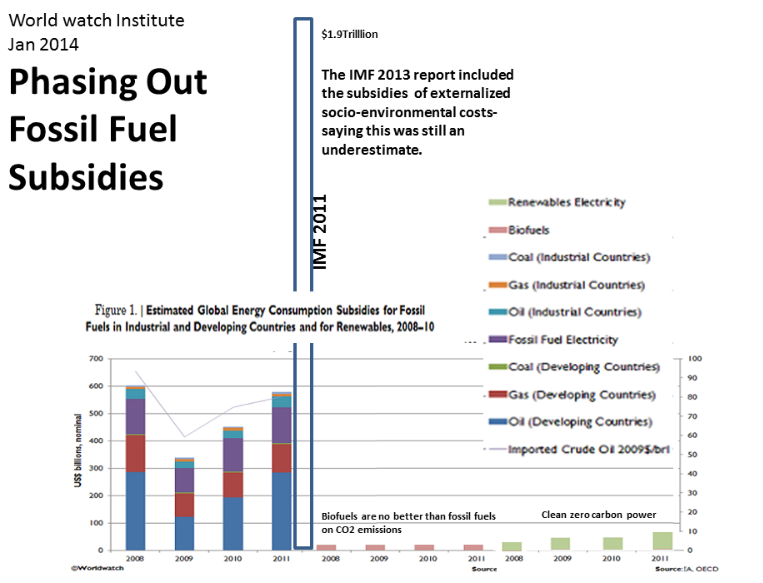
IMF in 2013 had calculated world fossil fuel subsidies at $1.9 trillion a year - and the report says that is an underestimate. This staggeringly large amount was calculated from pretax (direct) and also post tax (indirect) subsidies. Most of the post tax amount is from externalities (see below What are externalities?).
The top three nations for fossil fuel subsidies:
United States $502 billion.
China $279 billion
Russia $116 billion.
Another 2013 report on global economic externalities by TRUCOST indicates world greenhouse gas polluting promoting subsidies are at least $3Trillion a year.
The IMF includes these externalities as post tax subsidies or indirect subsidies.
Fossil fuel externalities
TRUCOST GHG pollution externalities = $2.7Trillion
Assume CO2 is @50% of all GHGs = $1.4Trillion
TRUCOST Air pollution = $0.5 Trillion
Total fossil fuel indirect/post tax subsidies alone (TRUCOST) = $1.9Tillion
Direct/pre tax fossil fuel subsidies (IMF) $0.48Trillion
Total Fossil fuel subsidies/year $2.4Trillion
Using the TRUCOST estimates on government subsidies to our industrial chemical intensive agriculture and to deforestation for the livestock industry we find total GHG pollution promoting subsidies are --- over $3Trillion a year.
A study of the scandalous fossil fuel subsidies that are destroying our future by the
IMF in 2013 had calculated world fossil fuel subsidies at $1.9 trillion a year - and the report says that is an underestimate. This staggeringly large amount was calculated from pretax (direct) and also post tax (indirect) subsidies. Most of the post tax amount is from externalities (see below What are externalities?).
The top three nations for fossil fuel subsidies:
United States $502 billion.
China $279 billion
Russia $116 billion.
Another 2013 report on global economic externalities by TRUCOST indicates world greenhouse gas polluting promoting subsidies are at least $3Trillion a year.
The IMF includes these externalities as post tax subsidies or indirect subsidies.
Fossil fuel externalities
TRUCOST GHG pollution externalities = $2.7Trillion
Assume CO2 is @50% of all GHGs = $1.4Trillion
TRUCOST Air pollution = $0.5 Trillion
Total fossil fuel indirect/post tax subsidies alone (TRUCOST) = $1.9Tillion
Direct/pre tax fossil fuel subsidies (IMF) $0.48Trillion
Total Fossil fuel subsidies/year $2.4Trillion
Using the TRUCOST estimates on government subsidies to our industrial chemical intensive agriculture and to deforestation for the livestock industry we find total GHG pollution promoting subsidies are --- over $3Trillion a year.
Greenhouse gas emissions and atmospheric greenhouse gas concentrations will continue on their present accelerating track to global suicide so long as the insane government Greenhouse gas Pollution Promoting Subsidies are not corrected i.e. stopped.
22 Oct 2015 Phasing Out Fossil Fuel Subsidies Would Result in Large Reduction in Greenhouse Gas Emissions by 2020—New Research
22 Oct 2015 Phasing Out Fossil Fuel Subsidies Would Result in Large Reduction in Greenhouse Gas Emissions by 2020—New Research
Greenhouse Gas Pollution Promoting Subsidies

What are externalities?
The 2006 UK Stern Commission report Economics of Climate Change said that the practice by economists of not accounting for the huge socio-environmental public costs of air water and GHG pollution by calling them uncosted 'externalities' makes global climate change the greatest and most far reaching market failure ever- and is not justifiable as we have estimates on these pollution costs. The practice of 'externalizing' these huge pollution costs then is the cause of global climate change, which can be readily corrected by government full cost accounting.
In the lead up to the 2012 UN Rio+20 conference NRDC, 350.org, Avaaz.org, and other leading groups lobbied world leaders to end the trillion dollar world wide fossil fuel subsidies. There were not even any recommendations made on the subsidies.
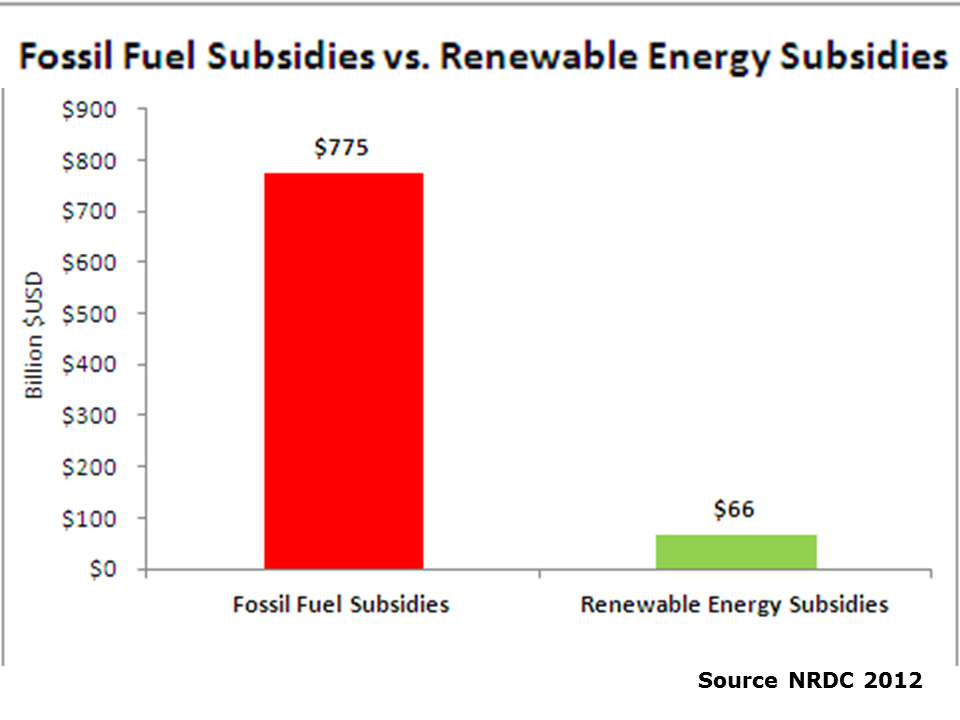
The fossil fuel industry is getting over ten times the subsidies that the clean energy industry gets.
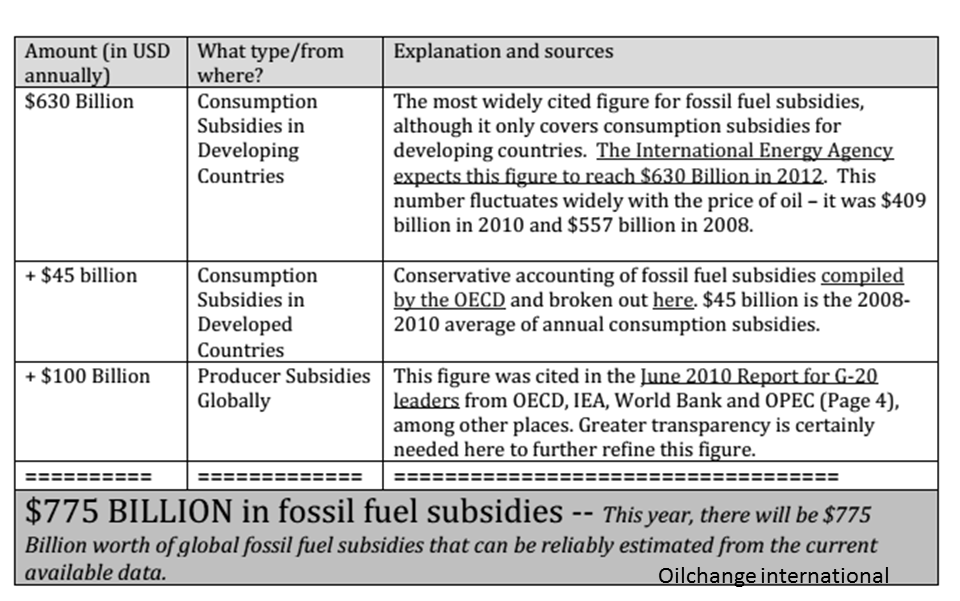
The NGOs pointed out that Recent estimates of global fossil fuel subsidies for production and consumption are staggering, putting the total near US$730 billion annually or higher.
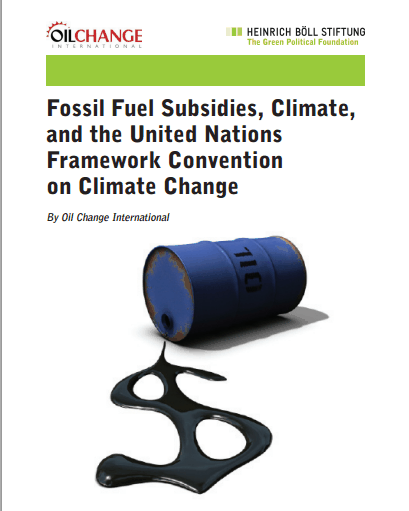
Fossil Fuel Subsidies, Climate, and the United Nations Framework Convention on Climate Change Oil change International 2012.
The Urgent Need for Transparency in Fossil Fuel Subsidies
Oil change International
In 2009, G20 leaders pledged to phase out fossil fuel subsidies. Nothing has happened. It doesn't help that there is no public accounting on just how much of our money governments provide in fossil fuel subsidies. The figures we have are best indirectly calculated and presumably minimum estimates.
The 2006 UK Stern Commission report Economics of Climate Change said that the practice by economists of not accounting for the huge socio-environmental public costs of air water and GHG pollution by calling them uncosted 'externalities' makes global climate change the greatest and most far reaching market failure ever- and is not justifiable as we have estimates on these pollution costs. The practice of 'externalizing' these huge pollution costs then is the cause of global climate change, which can be readily corrected by government full cost accounting.
In the lead up to the 2012 UN Rio+20 conference NRDC, 350.org, Avaaz.org, and other leading groups lobbied world leaders to end the trillion dollar world wide fossil fuel subsidies. There were not even any recommendations made on the subsidies.
The fossil fuel industry is getting over ten times the subsidies that the clean energy industry gets.
The NGOs pointed out that Recent estimates of global fossil fuel subsidies for production and consumption are staggering, putting the total near US$730 billion annually or higher.
Fossil Fuel Subsidies, Climate, and the United Nations Framework Convention on Climate Change Oil change International 2012.
The Urgent Need for Transparency in Fossil Fuel Subsidies
Oil change International
In 2009, G20 leaders pledged to phase out fossil fuel subsidies. Nothing has happened. It doesn't help that there is no public accounting on just how much of our money governments provide in fossil fuel subsidies. The figures we have are best indirectly calculated and presumably minimum estimates.
What are fossil fuel subsidies?
A negative subsidy with respect to climate change is any government policy that is a financial incentive to continue to produce or use more fossil fuels, or that results in negative externalities.
A positive subsidy is a financial incentive to switch from fossil fuel to clean zero carbon energy.
The justification for subsidies is to assist in the early development of an industry that produces an important public good or beneficial externalities.
An argument used for environmentally damaging subsidies is that they help the poor. In the case of energy subsidies, studies have found this is not the case. In any case, global climate change hits the poor in all regions earliest and hardest.
Energy subsidies are expensive, damage the climate, and disproportionately benefit the well- off. Their reduction can encourage energy efficiency, increase the attractiveness of renewable energy, and allow more resources to flow to poor people and to investments in cleaner power.
Climate Change World Bank Group. An Evaluation of World Bank Win-Win Energy Policy Reforms 2000.
A negative subsidy with respect to climate change is any government policy that is a financial incentive to continue to produce or use more fossil fuels, or that results in negative externalities.
A positive subsidy is a financial incentive to switch from fossil fuel to clean zero carbon energy.
The justification for subsidies is to assist in the early development of an industry that produces an important public good or beneficial externalities.
An argument used for environmentally damaging subsidies is that they help the poor. In the case of energy subsidies, studies have found this is not the case. In any case, global climate change hits the poor in all regions earliest and hardest.
Energy subsidies are expensive, damage the climate, and disproportionately benefit the well- off. Their reduction can encourage energy efficiency, increase the attractiveness of renewable energy, and allow more resources to flow to poor people and to investments in cleaner power.
Climate Change World Bank Group. An Evaluation of World Bank Win-Win Energy Policy Reforms 2000.
ONLY ZERO CARBON ONLY ZERO CARBON ONLY ZERO CARBON ON LY ZERO CARBON ONLY ZERO CARBON ONLY ZERO
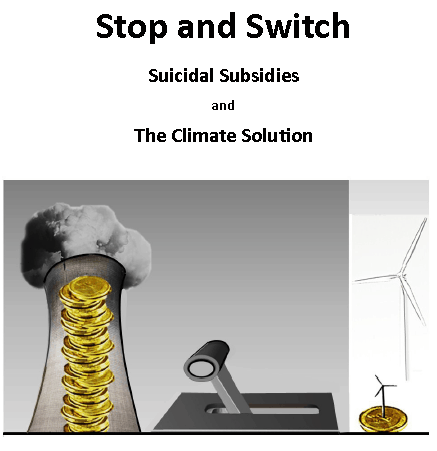
STOP & SWITCH: Suicidal Fossil Fuel Subsidies PDF
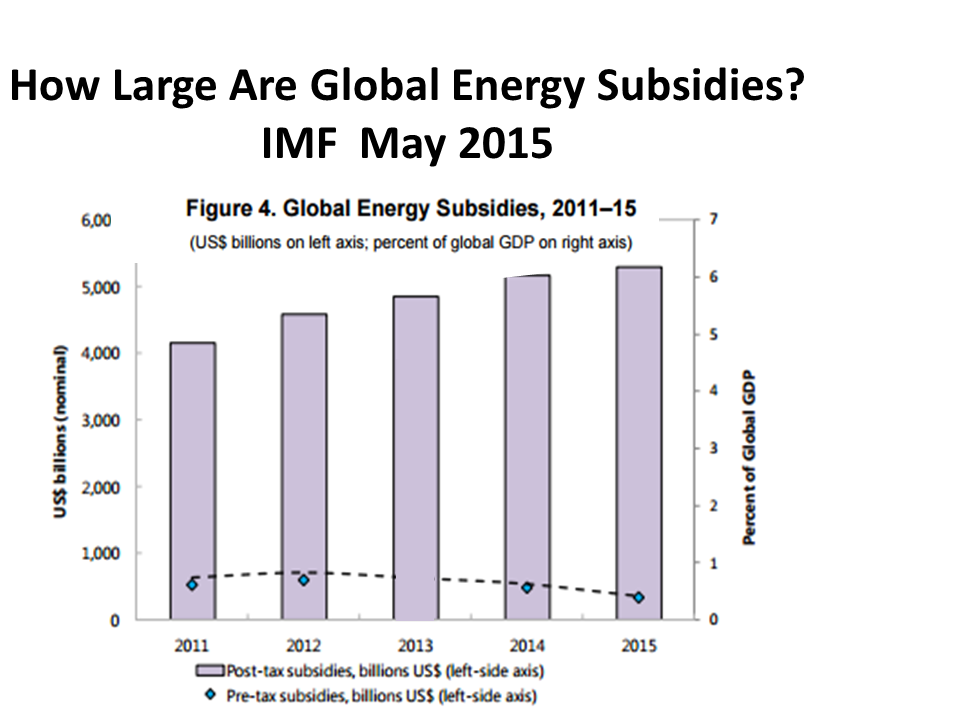
$5 Trillion US/year
Mar 2016 U. Calgary Into the mire:a closer look at fossil fuel subsidies.
A different methodology shows $Trillions.
A different methodology shows $Trillions.